
This article is for people who want to drive more branded and non-branded organic search traffic from search engines and chatbots to their organization’s website as part of an overall content marketing strategy.
Table of Contents
- Resist inline self-promotion
- Involve SMEs (subject matter experts)
- Create pillar pages and content clusters
- Use AI authoring judiciously
- Include unique information
- Determine search intent
- Do topic and keyword research
- Research semantically related keywords
- Get into the correct Google content category
- Don't spend time optimizing for advertisers' keywords
- Use a clean heading/subheading structure
- Structure your URLs properly
- Optimize images
- Optimize off-page elements
- Acquire authoritative, relevant backlinks
- Disavow certain purchased links
- Add relevant internal links
- Distribute your content
- Ensure your content is indexed
- Manage your content like other organizational assets
- Increase website speed & improve core web vitals
- Maintain your website's health
- Pay attention to spelling and grammar
- Consider readability
- Add canonical links
- Make sure text and backgrounds have sufficient color contrast
- Include an RSS feed link in your footer
We commonly discover websites with dozens of blog posts but negligible organic traffic to that content.
The reason for this ‘low to no’ search traffic is simple. Most of the rules for getting found through online search were never implemented.
Content that adheres to rules and best practices can be a valuable, permanent organizational asset, and it should be created and managed accordingly if the goal is to increase website search traffic.
Getting more website traffic through SEO and GEO is the sum of many minor improvements — and sometimes a few major ones.
This may seem like a long list of considerations to keep in mind when creating content, but Google considers over 200 factors in ranking. AI Agents can do some of the remembering for you.
Use the ideas below to guide new content and update your website’s existing content. While we frequently mention Google, SEO practices are foundational to GEO. Google’s AI Mode falls under GEO.
After making changes, you can check Google Search Console to see whether your efforts have increased organic search traffic and to which pages and posts.
Resist inline self-promotion
The default mode for many writers unfamiliar with SEO and GEO is to pepper blog posts with mentions of their brand and promotions for products and services.
This approach runs counter to organic search goals.
Keep content objective. For visitor conversions, use header, sidebar, and bottom-of-post CTAs.
Website pages are for promotion. Blog posts are for educating and answering audience questions.
Involve SMEs (subject matter experts)
E-E-A-T (Experience, Expertise, Authoritativeness, and Trustworthiness) is part of Google’s Search Quality Rater Guidelines. This is the handbook that human raters use to evaluate the quality of search results.
Google’s September 2023 Helpful Content Update, which punished many niche sites and recipe bloggers, emphasized the Es in E-E-A-T.
Author and analyst Dr. Marie Haynes said, “Google wants to recommend content from people known for their expertise on a topic, not just marketers creating content.”
Ideally, content creators should write about things they have first-hand experience with. Alternatively, writers can interview and quote SMEs.
Create pillar pages and content clusters
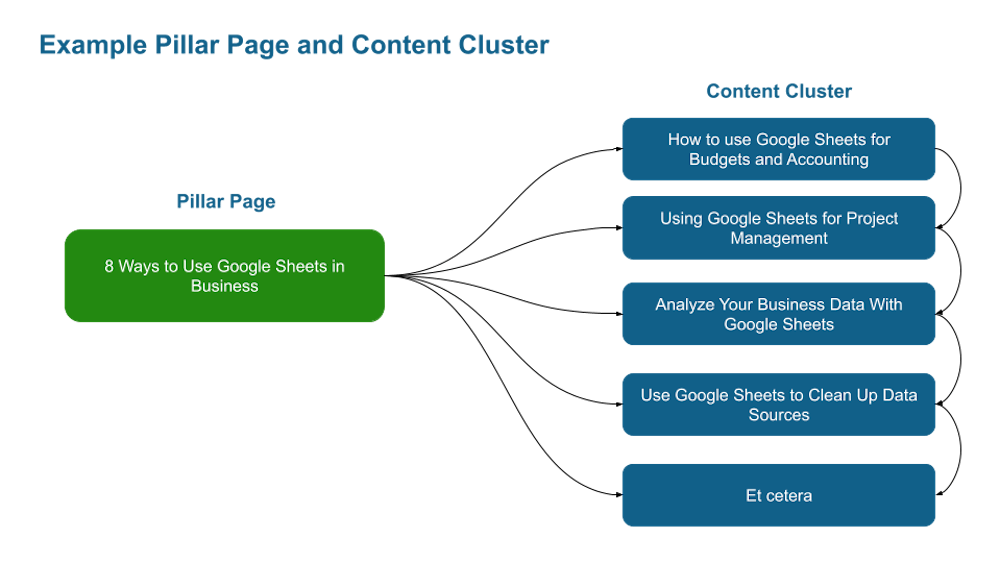
Let’s say you sell a Google Sheets add-on for businesses.
Your pillar page could be “8 Ways to Use Google Sheets in Business.”
Your content cluster could then be detailed posts regarding those eight ways.
Use AI authoring judiciously
Our original advice was to avoid publishing AI-generated text verbatim and to instead use AI for things such as:
- Inspiration
- Outlines
- Titles & meta descriptions
- Researching statistics
However, many SEO experts, including Ryan Law of Ahrefs, now say that AI content is good enough.
A 2026 study from SEMRush concludes that in the highest-ranking positions, human-written content clearly leads.
A hybrid approach to content with an AI and a human collaborating often produces the best results.
Remember, if it’s all AI, it’s all already in the training data.
Include unique information
Your content will be more attractive to readers and, therefore, more interesting to Google if it includes some unique elements.
This type of content can be original research data that people can’t find anywhere else. It could be a real-time database of information that people seek.
This approach is high effort, but can produce strong results, as pointed out by Zyppy Signal.
Determine search intent
Before settling on a topic, focus on search intent.
Here’s a lesson on what not to do.
We once published a blog post that ranked highly for ‘CRM administrator.’ The post was intended to inform business managers and executives about the value of having a CRM admin.
However, based on the search results, that particular keyword attracted job seekers rather than our target audience. Here were the top 10 organic results for the keyword:
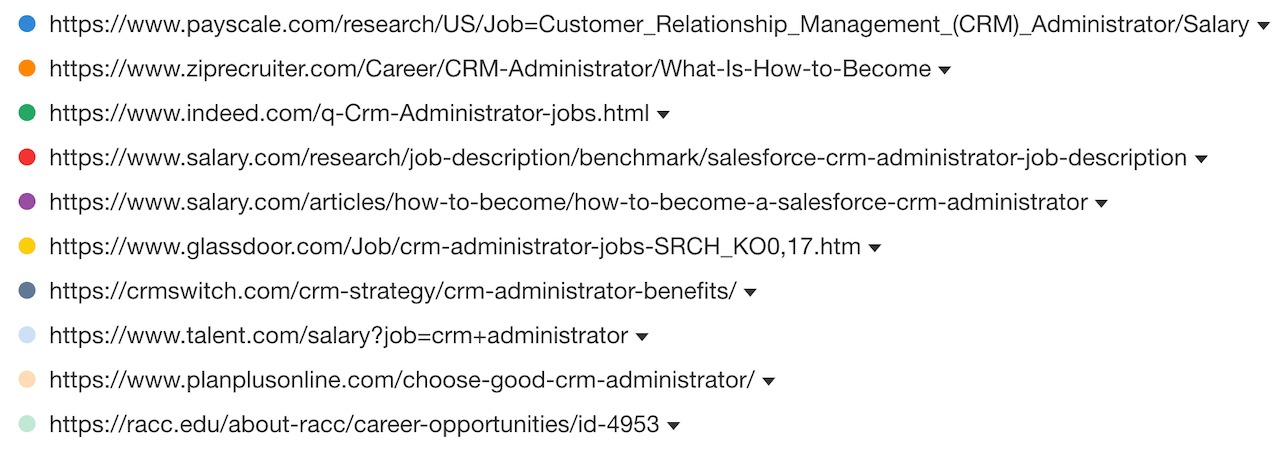
Failing to consider search intent can mean attracting the wrong overall audience for your product or service.
Do topic and keyword research
Keyword research for your topic is still essential for any blog posts or pages you want people to discover through online searches.
Keywords are also called search terms — a ‘keyword’ is rarely one word.
Premium keyword tools include SEMRush, Ahrefs, KWFinder, and KeySearch.
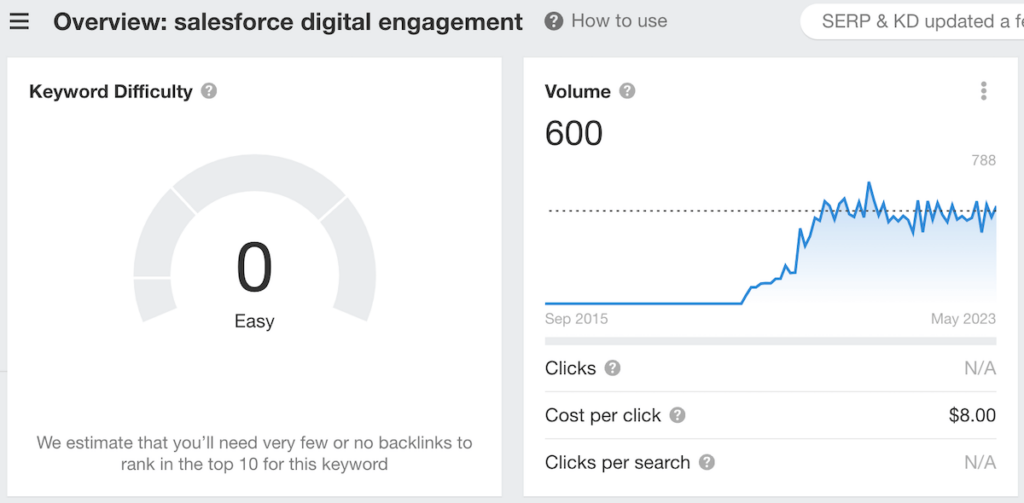
One approach is to identify moderate- to high-volume, low-competition keywords related to your topic. For example, if your organization specializes in digital engagement on the Salesforce platform, “Salesforce digital engagement” would, on paper, be a good topic to target.
It’s also best to focus on at least three-word search terms. According to NP Digital, “If you remove brand queries, 77.91% of organic conversions come from search terms that are 3 or more words.”
Remember that helpful, well-optimized pages and posts can rank for dozens or hundreds of keywords.
If you create content for difficult keywords, don’t expect the content to be found through search. Instead, focus on keywords with good traffic potential and low difficulty.
It’s vital to differentiate your business competitors from your keyword competitors. Your keyword competitors are always your friends because they provide valuable insights.
Research semantically related keywords
Google’s Natural Language AI looks at more than page and post keywords. It also looks at all the words related to that keyword. It wants those related words to be in the proper context relative to the keyword.
Semantically related words, also known as LSI (Latent Semantic Indexing) words, are those that Google’s Natural Language AI has determined to be relevant to the main topic. Google refers to these as Entities.
If your page is about ‘bookkeeping, words like ‘general ledger,’ ‘balance sheet,’ and ‘income statement’ would naturally appear as well.
Google provides developers with an API. Developers can create apps that feed content to the natural language understanding engine, which responds with its interpretation of the words.
In our search intent example above, Indeed.com may have ranked higher for ‘CRM administrator’ if it added more of the words in red from the following to its job listing:

Recommended words like these need to appear within the content so that they read naturally.
Google Search Console shows you pages with a low clicks-to-impressions ratio. Some of these pages may be candidates for adding more LSI words, which can positively impact SEO.
Get into the correct Google content category
Google’s NLU also uses category matches for ranking purposes. Google categorizes every page and post that it crawls.
Currently, there are over 600 content categories.
Your content is more likely to outrank other top-ranking content for a given keyword if your page or post is in the same category as the content you are trying to outrank.
To determine the top category, Google’s natural language engine analyzes words on an individual page and across an entire site.
Don’t spend time optimizing for advertisers’ keywords
There are specific topics where ads dominate the top of search engine result pages (SERPs). For example, if you search for ‘CRM software’ or ‘accounting software,’ you often won’t see the first organic search result until you scroll below the fold.
For keywords related to heavily advertised products and services, the juice might not be worth the squeeze. The number of ads will overwhelm the organic results.
On the other hand, if you decide to optimize for a common Google Ads keyword, you may still get clicks to your website from people who automatically scroll past ads.
Use a clean heading/subheading structure
Many website designers and bloggers overlook proper heading structure.
Sometimes, website theme headings are used for design rather than structural purposes.
For better SEO, it’s essential to structure (or restructure) your pages and posts to have one H1 heading and multiple hierarchical subheadings (H2s and H3s) in the body text.
But it’s not uncommon for website pages to have multiple H1 headings. We have seen pages for which the designer used over 20 H1s.
Mechanically, changing to a proper heading structure is an easy SEO fix. This 𝕏 post includes an excellent graphic that outlines the overall structure of a blog post.
Structure your URLs properly
By default, most content management systems create a blog slug (the last part of the URL) that incorporates the entire post title.
Google prefers brief and descriptive URLs and says that “users and search engines identify concepts in a URL more easily” when text is separated by hyphens rather than underscores.
For example, rather than using a URL like this:
https://www.example.com/customer-stories/How_Our_Software_Helped_Acme_Corporation_Increase_Its_Sales_By_100_Percent/
Use one like this:
https://www.example.com/customer-stories/acme-corp-sales-increase/
Here’s more on structuring your URLs.
Optimize images
A common practice among website designers is to retain the original filename of a stock photo or the filename assigned by Adobe Illustrator or a smartphone.
But keyword-rich filenames are an SEO opportunity.
Rather than using an image filename like this:
Depositphotos_33099063_L.jpg
Use one like this:
seo-strategy.webp
Add alternative (alt) text in your CMS editor using a variant of the image’s filename, such as “Your SEO Strategy.”
For page speed reasons (more on speed below), scale images to 1200 pixels wide. Then, compress the image using an app like TinyPNG.
Make sure that every page and post has a featured image.
Optimize off-page elements
Off-page mainly consists of a page or post’s meta tags. You can see these by selecting ‘View > Developer > View Source’ in Chrome.

You can still find homepage meta titles with the format ‘Company Name – Home.’ The title on your homepage, every other website page, and every post is a golden opportunity to tell people what your company does when they see a snippet of your website in search results.
Remember that the on-page title people see when reading the page can differ from the off-page title, which appears in the search results.
Another important off-page meta tag is the Meta description. Even though Google rewrites the Meta description well over half the time, it’s worth adding descriptions to all your pages and posts.
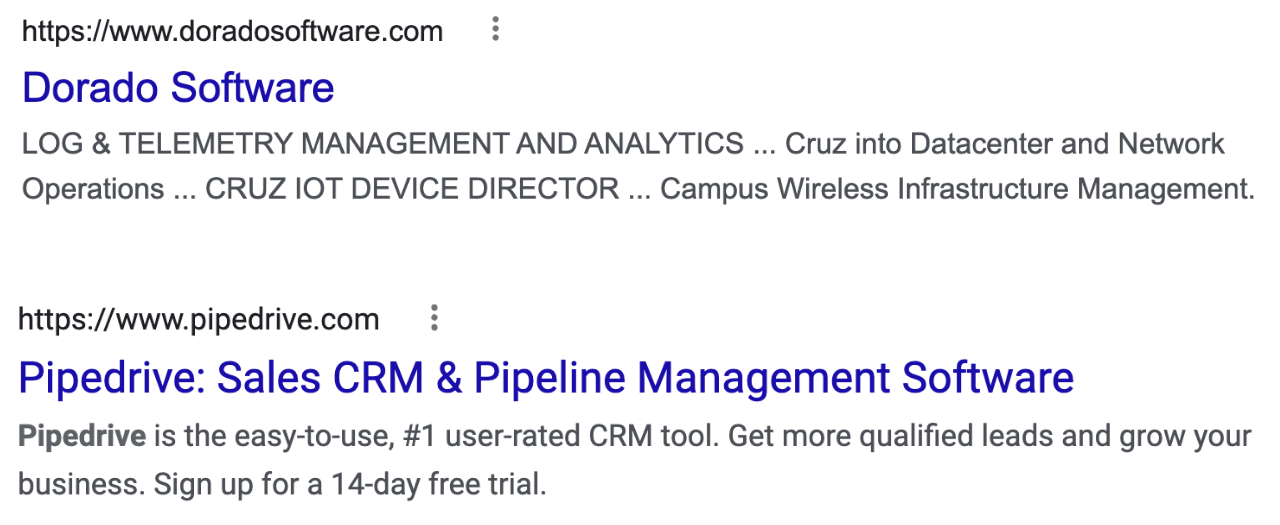
Notice the difference in the level of information between the following two Google search engine result snippets. The second one has a descriptive meta title and description.
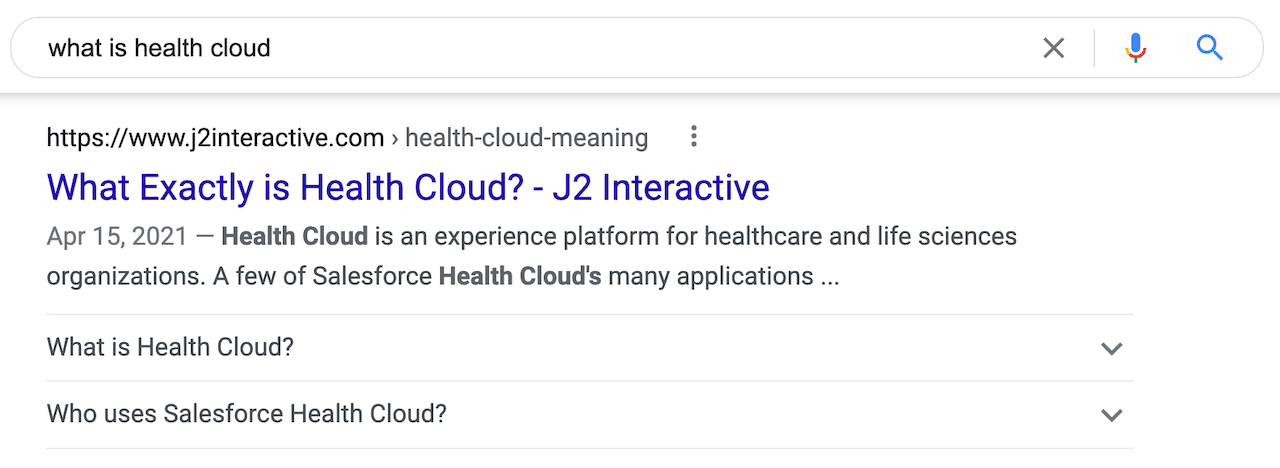
Structured data markup, such as FAQPage Schema, is another off-page element that can make your pages rank higher. FAQPage Schema involves having an FAQ section on a page and matching the questions and answers word-for-word, off-page, in JSON-LD format.
Alternatively, you can use the Yoast FAQ block, as we did at the end of this post.
If you add this schema, you may see a rich snippet in the SERPs that makes your result stand out visually.
Acquire authoritative, relevant backlinks
Google presented a slide to the U.S. Department of Justice, which included, “We do not understand documents. We fake it.”
Google can’t directly determine whether one article is better by reading two articles on the same topic. So, it has to rely on other signals, like quality backlinks.
The best backlinks are from websites with the most authority. One measure of authority is Ahrefs’ Domain Rating.
Think of backlinks as votes from the internet for your keywords.
The content category of the linking content is also essential, as a matching category means higher relevance.
The best way to get quality backlinks is to create and distribute content that people want to link to.
Certain types of content lend themselves to organic backlinks. These include deeply researched articles and calculators.
Startups should consider setting up foundational backlinks.
Disavow certain purchased links
Many SEOs are now openly admitting that they pay for backlinks. However, most of these result from one-to-one outreach and are probably not detectable by Google.
However, if you purchased backlinks from link brokers in the past, consider disavowing those links.
Google announced a link-spam update in December 2022 targeting sites with purchased links. It would be prudent to disavow any links you’ve purchased through brokers.
Add relevant internal links
If your website has a high-ranking page or post and you publish a new post on a related topic, link the former to the latter.
Those links can pass on authority from older pages to newer pages, which can result in more traffic—sooner—to your new pages.
One SEO case study suggests that having more internal links is better than fewer, but only to a point. Mixing up your internal anchor text is generally recommended.
Distribute your content
Distributing your content across social media, Google News, and your Google Business Profile (GBP) can prime the SEO pump.
Content distribution can drive awareness, which may, in turn, result in additional high-quality backlinks.
You can also atomize your content — break it into smaller pieces before distributing it. Ross Simmonds is a guru of content distribution.
Ensure your content is indexed
Your content cannot be found through a Google search until it is in the Google index.
It’s common for people to be unaware that some of their website’s content is not in the Google index.
Paste a URL into the top field in Google Search Console and hit ‘Enter’ to see if the page or post is in the Google index.
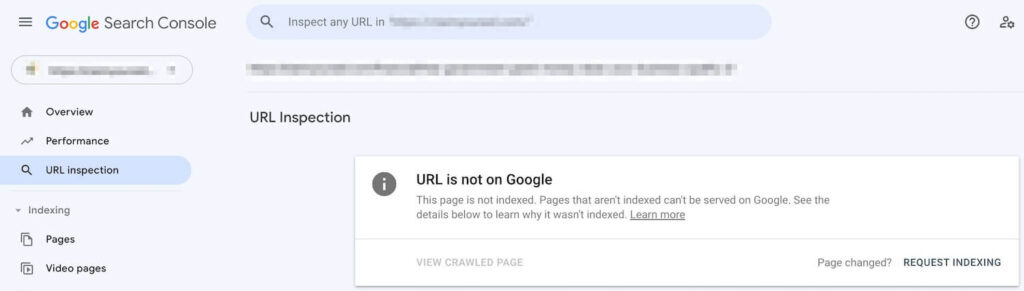
If the URL is not on Google, click ‘Request Indexing.’
If your site has a low Domain Rating, you may need to take other measures to get your content indexed.
Manage your content like other organizational assets
Helpful, well-optimized content can be a permanent asset to your organization. If you regard your website’s posts and pages as assets, they will get more attention.
Internally, we set up a marketing asset management system to support content creation and re-optimization.
This allows tracking of many data points for each piece of content and the discovery of ways to increase its online visibility.
Increase website speed & improve core web vitals
Your website’s performance affects how search engines view your content.
You can use Google’s PageSpeed Insights to get a user experience report on both mobile and desktop.
If you’re designing a new website in WordPress, consider using the WordPress block editor plus a blocks plug-in instead of a third-party page builder. Regarding website speed, there is a beauty/bloat tradeoff to some degree.
Maintain your website’s health
A tool such as Ahrefs’ Site Audit, part of the company’s free Webmaster Tools offering, will give you an extensive report of website issues. The three categories are errors, warnings, and notices.
Error types include internal links from HTTPS to HTTP, broken internal links, broken images, too-large images, and 404 pages.
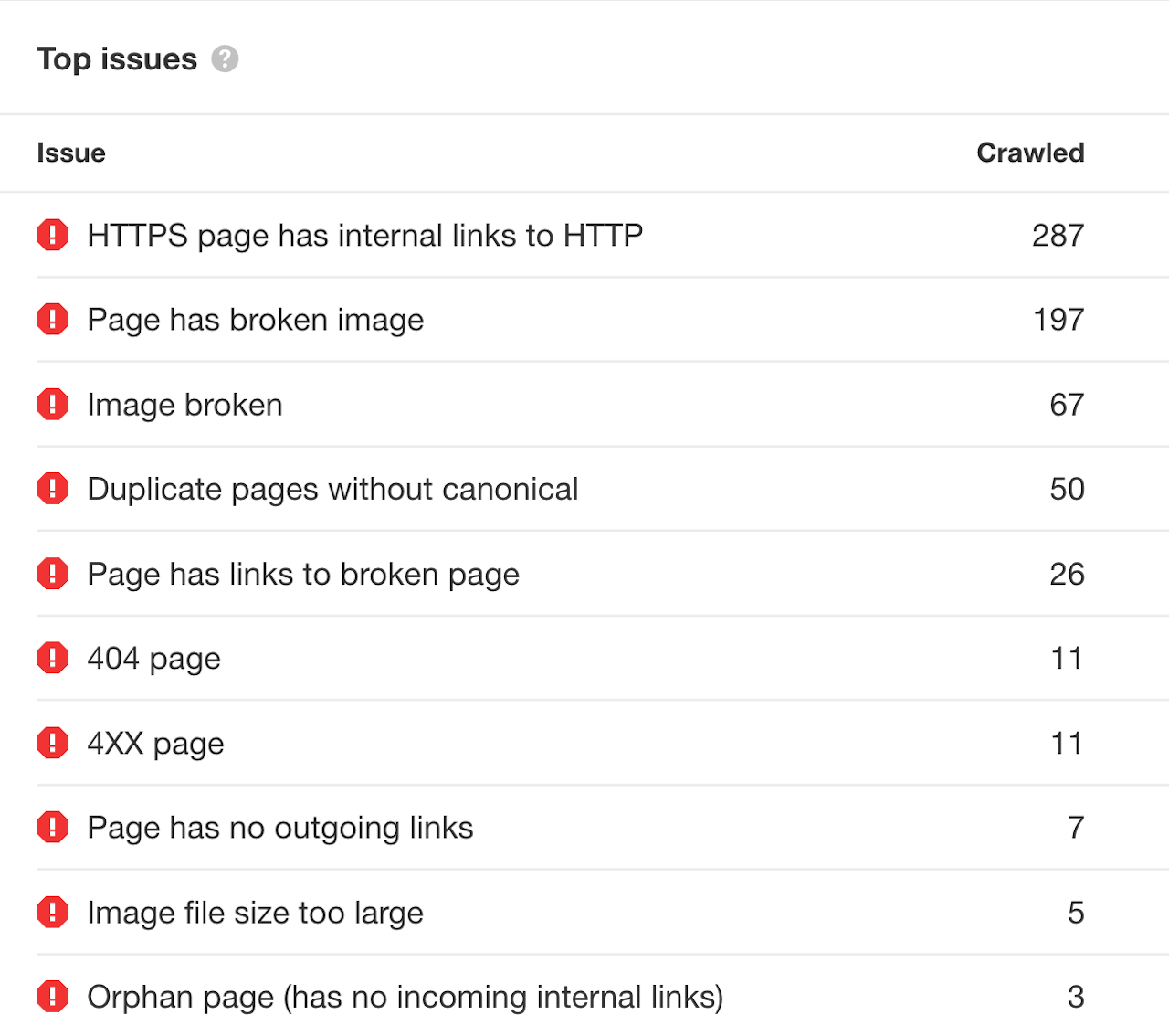
You will improve your website’s overall SEO by systematically fixing pages with errors and warnings.
Pay attention to spelling and grammar
Typos and grammatical errors can adversely affect SEO.
The free version of Grammarly and one of its browser extensions can improve SEO by alerting users to basic mistakes as they type within a browser tab.
Grammarly’s extension works with almost any text block within a browser tab, including website page editors and Google Docs.
Consider readability
There are a variety of factors that make your writing more readable. Better readability can boost SEO.
These factors include using short sentences and paragraphs, using enough transition words, and using enough active voice.
Add canonical links
Canonical links are used to avoid issues caused by duplicate content.
A canonical link tells search engines which page is preferred or most authoritative.
For example, if you have two nearly identical versions of a product page — one with U.S. spellings and one with U.K. spellings — you can add a canonical link that points from the U.K. version to the U.S. version.
Make sure text and backgrounds have sufficient color contrast
Many web designers prioritize ‘a look’ over whether a website meets various accessibility standards.
Use a tool like WebAIM’s Contrast Checker to ensure sufficient contrast ratios.
You can also use WebAIM’s WAVE Chrome or Firefox plugin to do full-page accessibility audits.
Include an RSS feed link in your footer
Make sure your blog syndication feed is set for a number that shows all your posts.
Add an RSS icon to your footer, like the one you can see in the footer of this page.
Pull your feed into a Google Sheet using the IMPORTFEED function and then publish the sheet. Set sharing for ‘Anyone with the link.’
Improved visibility in chatbots and search engine rankings often results from many things done right, particularly when trying to get your content to rank for competitive keywords.
If you spend time on enough of the little things and a few of the big things, you may be able to propel some of your content higher in the search engine results — in some cases, much higher.
You can convert more visitors into prospects and customers with the right conversion words and actions.
There are no guarantees when it comes to search engine optimization efforts.
But if you consistently incorporate many or all of the above tips, you will improve the positions your pages and posts hold in the eyes of chatbots and search engines.
Frequently Asked Questions
SEO is an acronym for Search Engine Optimization. It is a set of practices that, when applied, improve a website’s content relevance, link relevance, and technical setup. These practices make a site’s pages and posts easier to find through user search queries.
SEO aims to achieve a higher ranking in search engine results for a query from a prospective reader of your content or a buyer of your products and services.
Popular subscription-based tools include SEMRush Keyword Magic Tool, Ahrefs Keywords Explorer, Keyword Keg, and Wordtracker. These are all excellent sources of keywords, but the features vary among vendors.
If you have full editing rights to your website, you can make a range of changes to existing on-page and off-page content to boost your website’s SEO.
It’s best to use an AI writer for inspiration and guidance. Using AI-generated content word-for-word may produce short-term results but not long-term ones if search engines detect it as AI-written.