
Backlinks are links from other websites to yours. Google still uses them, but which ones you earn, and how, matters far more than how many you have.
If your domain is new, start with our companion post on foundational backlinks, the starter set of links every new website should have. This post is about what comes next: earning links that actually carry weight.
Do backlinks still matter?
Yes, though less than they once did. In 2022, Google’s John Mueller said that Google does use links in its ranking algorithms, but that their weight as a ranking signal will likely decline over time. Links also help Google discover your pages in the first place.
For a new site, the bigger issue is trust. Until sites that search engines already trust start linking to you, your content has a hard time competing.
What makes a backlink valuable
It comes from an authoritative website
Google doesn’t publish an authority score, so SEO tools estimate one. We like Ahrefs’ Domain Rating, which is measured on a logarithmic scale from 0 to 100 based on the size and quality of a site’s backlink profile. A brand-new domain starts at 0. Links from higher-rated domains generally help more, but a third-party score is a proxy, not a Google metric.
It comes from a relevant website
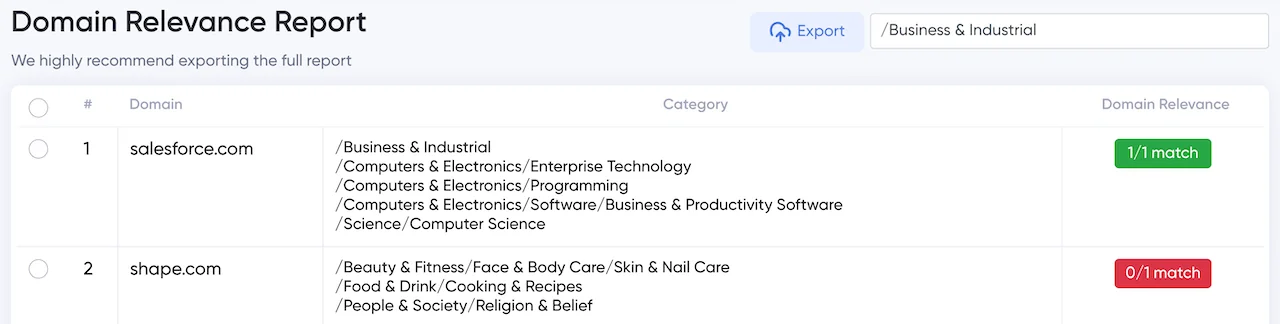
A link from a site on the same topic as yours makes more sense to readers, and to search engines, than one from an unrelated site. If you write about CRM software, a link from a business software site is a better fit than one from a beauty and fitness site. Some SEO tools classify domains into topic categories to help you check that fit.
It passes ranking credit
“Dofollow” isn’t a real HTML attribute; it’s shorthand for a normal link with no qualifier. Google asks sites to qualify certain outbound links with rel="sponsored" for paid placements, rel="ugc" for user-generated content such as comments and forum posts, and rel="nofollow" when the site doesn’t want to be associated with the linked page. Qualified links can still send visitors, but an unqualified editorial link is the kind that helps rankings.
It sits in rich, relevant content
A contextual link inside a well-written article is generally worth more than a link from a business listing page.
Questionable uses of your time
Some of these tactics are merely low-value. Others are specifically named in Google’s link spam policy, which defines link spam as creating links to or from a site primarily to manipulate search rankings.
Buying backlinks
Google’s spam policy lists buying or selling links for ranking purposes as link spam, including exchanging money, goods, or services for links. Paid links are fine for advertising, as long as they carry rel="sponsored" or rel="nofollow", which means they won’t pass ranking credit anyway. And in 2020, John Mueller said that when sites buy a ton of links, Google ignores them.
Exchanging backlinks
“Link to me and I’ll link to you” at scale is also on Google’s list: excessive link exchanges, and partner pages that exist only for cross-linking, count as link spam. Linking to a genuine partner is fine; trading links as a tactic isn’t.
Dropping links in comments and forums
Anywhere you can easily add a link yourself, the site owner has usually qualified it as ugc or nofollow; otherwise the site would become a magnet for irrelevant links. Forum comments with optimized links in the post or signature are one of Google’s own link spam examples. Participate to help people, not to collect links.
Mass cold outreach
The template is familiar. It opens with flattery, suggests your content is out of date, and offers its own article as a way to “enhance” yours, often with a promise to share your post on social media.
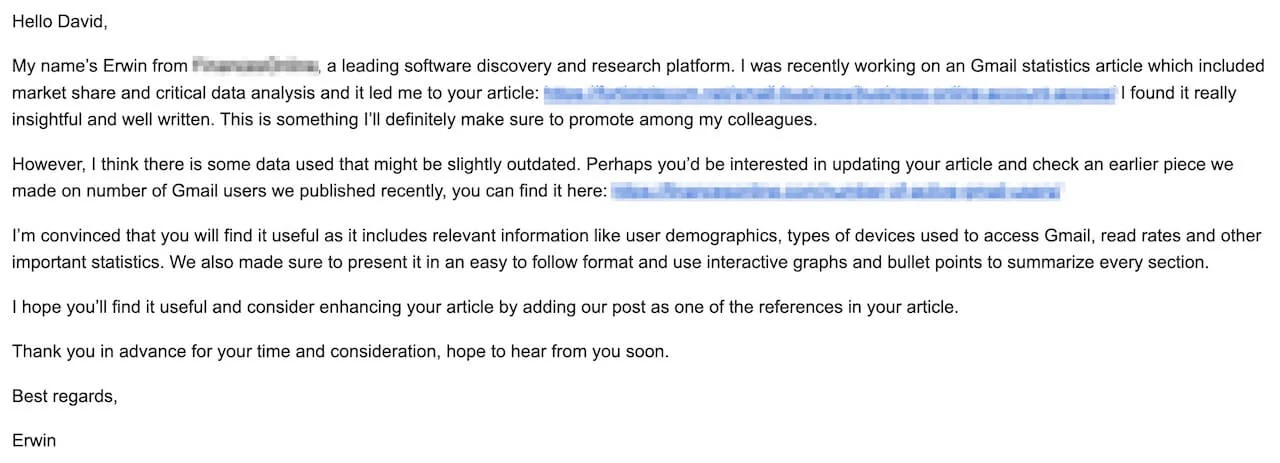
Most people who receive these emails have long since reached saturation. They ignore or block the senders.
Better uses of your time
Remember that the quality of backlinks matters more than the quantity.
Warm outreach
Start with people who already know you. If your company is a partner of a software vendor or a distributor for a manufacturer, you probably have content that puts that vendor in a good light. Ask your contact there whether a link makes sense.
If a partner or customer site links to you only through a logo pointing at your home page, ask whether they’d link with descriptive anchor text to a relevant interior page instead, such as a post you want to rank. You can also ask peers at complementary businesses, and offer to write something useful for their site in return. Just keep it editorial: Google’s policy flags exchanging goods or services for links, and links with optimized anchor text in guest posts.
Ask your SEO or marketing agency
Agencies tend to publish a lot of content, so their domains often carry decent authority. A link from one of their articles to one of your posts is worth more than a logo on their client page.
Create link-worthy content
Bloggers and journalists link to things they can cite: original statistics, survey results, and niche calculators or tools. These attract links that text-only posts rarely earn.
The catch is effort. A useful calculator or an original survey can take many hours of internal time, and often a paid developer or data budget. Choose a topic where a resource like that doesn’t exist yet.
Publish helpful content consistently
Consistently publish helpful, well-optimized content. Over time, other writers discover it, and some find a post worth linking to. This is a long game; it can take years for a small site’s Domain Rating to climb meaningfully. We know from experience.
Build focused relationships
If your Domain Rating is near zero and you’re publishing a lot, targeted relationship-building is the fastest way to speed things up. That means researching relevant, well-regarded sites, getting to know the people who run them, and only then offering to contribute. Write genuinely useful pieces and let the editor decide how to link; a guest post written mainly to plant optimized anchor text is exactly what Google’s link spam policy describes.
Add platform backlinks
Some platforms give you a link just for having a profile: business directories, social profiles, link-in-bio pages, and builder profiles. Most are qualified links that won’t move rankings much on their own, but they help establish your site and brand. Our foundational backlinks post covers which ones to set up first and how to wire them together.
NoteAn earlier version of this post suggested linking your website from custom GPTs in ChatGPT. OpenAI now says personal ChatGPT accounts can’t create or publish new GPTs, and it plans to retire custom GPTs in favor of plugins, so we no longer recommend it.
Conclusion
There are plenty of legitimate ways to earn links, and they all take more effort than buying, trading, or spamming them. Avoid anything Google describes as a link scheme, put your time into relationships and content people want to cite, and make sure your foundation links are in place first.