
If you’re launching a new brand or considering a rebrand, there’s a question worth asking before you settle on a name:
Will search engines and AI assistants recognize, retrieve, and recommend your brand without confusing it with generic terms or competitors?
That question matters more than it used to. A growing share of discovery now happens inside ChatGPT, Claude, Gemini, Perplexity, and Google’s AI Mode. These platforms are more likely to surface your company first if they can cleanly identify your brand as a distinct entity.
A name that’s ambiguous or common may divert attention to your competitors when someone asks an AI for a recommendation.
Here’s a tool that will save you time for existing and prospective brands.
What does a brand name have to do for an AI assistant?
Three jobs, and they happen in this order. If the name fails the first one, the other two never get a chance.
- IdentifyLet the model find the right entity quickly.
- DisambiguateSeparate your brand from generic terms or similarly-named companies or products.
- RecommendSurface your brand when the query is relevant.
Success means the model knows exactly which brand you queried.
No more “did you mean?…”, no blending you into a category description, and no recommending the bigger competitor whose name overlaps with yours.
What makes a name easy for a model to resolve?
Four traits, and they show up together. After looking at brands that consistently get cited well by LLMs, a pattern emerges:
What the pattern looks like
- One word
- 2–3 syllables
- Non-generic (not a category term)
- Easy to spell and pronounce
How do you check a name before you commit?
Four checks, and they take an afternoon. Do them before you fall in love with the name, not after the logo is drawn.
Before you commit
- Avoid generic words and crowded acronyms.
- Check the major AI assistants to see what already comes up for that name.
- Verify domains and social handles are available.
- Plan to build a presence across both owned (your site) and non-owned (third-party citations, listings, mentions) platforms.
Which brand names do AI assistants handle cleanly?
Names that exist as a single, unambiguous string. Here are a few examples of distinct, memorable, searchable names that assistants handle cleanly:
- Clearspeed
- JumpCloud
- HubSpot
- Smartleaf
- Breakcold
- StackBlitz
- KeySearch
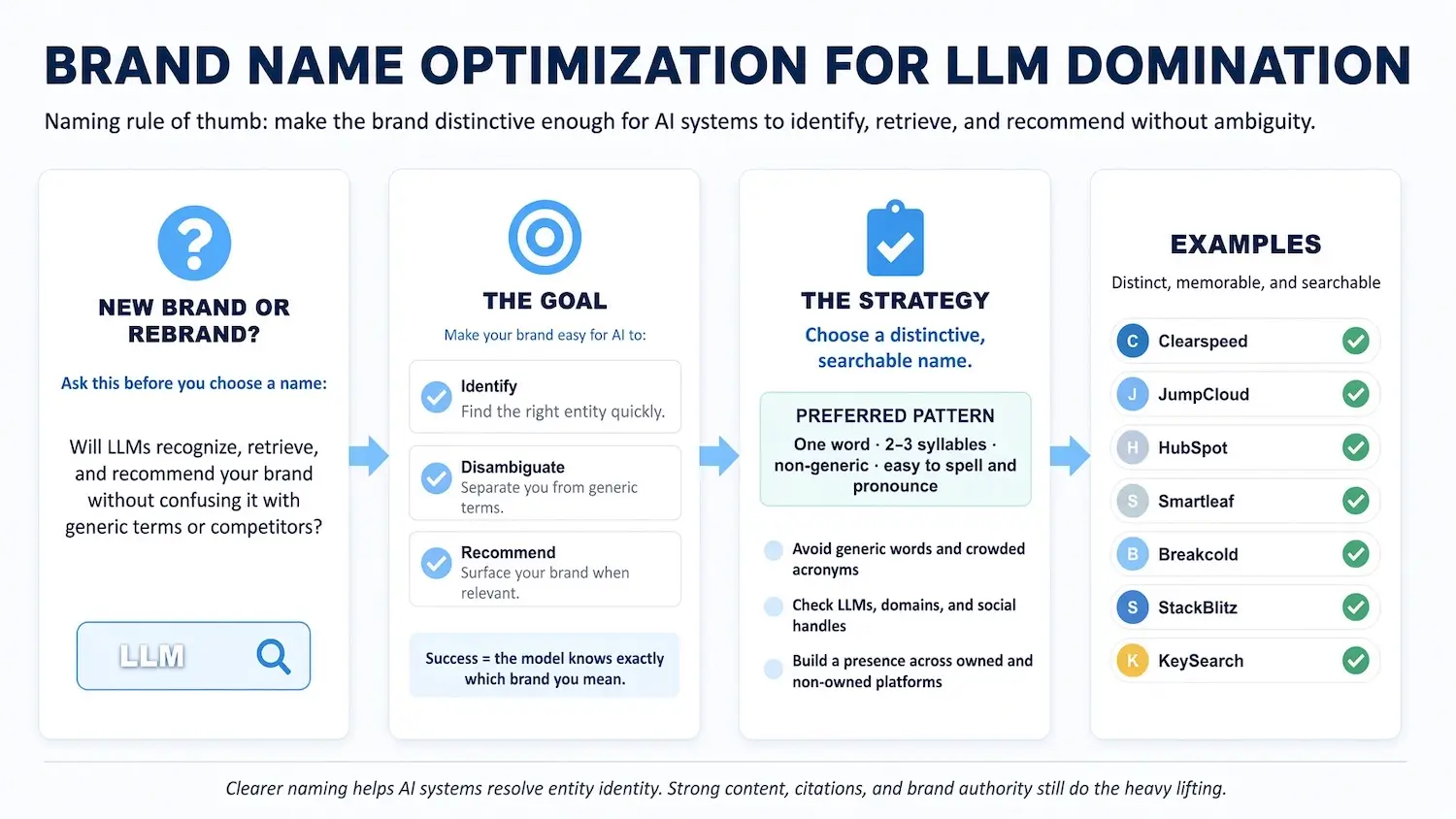
None of them is generic. None of them match a common phrase. Each one is a unique string that the model can tie to a single entity.
Take Breakcold. If you drop that name into Google’s AI Mode, ChatGPT, or Claude, you get information about the company, not a result about hypothermia.
Which brand names create problems?
Names assembled from category words and common English nouns. They read well on a sign and give a model nothing to hold onto:
- Summit Consulting
- Apex Products
- Pinnacle Solutions
- Meridian Group
- Premier Choice Services
Each one describes a category rather than naming a company. Here is the same comparison from the model’s side:
| Name | Pattern | What the model has to work out |
|---|---|---|
| Breakcold | One word, invented | Nothing. One company, one spelling, no competing meaning in ordinary English. |
| StackBlitz | Compound, distinctive | Nothing. The capitalization varies in the wild, but the string does not. |
| Summit Consulting | Common word plus category | Which of the firms sharing that name, in the same category, in a different city. |
| Premier Choice Services | Generic phrase | Whether this is a company at all, or a description of one. |
Illustrative examples, not a ranking study.
An important caveat
A clean, distinctive name makes entity resolution easier, but it’s only part of online branding.
Authoritative content across the open web can influence whether an AI assistant leads with your organization.
The name
Removes friction.
Your effort
Gets you on the recommendation list.
If you’re considering a new brand, use the AI assistant check for current brand presence, possible trademarks, and a domain check. A quick test that can save you years of trying to promote an ambiguous name.
Frequently asked questions
Does a distinctive name help traditional SEO too?
Yes. A unique string is easier to rank for, easier to track in branded search, and easier to clear at the trademark office. The property that lets a language model resolve your brand is the same one that lets Google do it.
Should we rename an established brand to improve AI visibility?
Usually not. A rename discards the citations, links, and mentions already pointing at your current name, and those are what put you on the recommendation list in the first place. It becomes worth considering when the current name is actively costing you attribution, such as when assistants keep returning a larger company that shares it.
What do we do if our name is already ambiguous?
Pair the name with a qualifier everywhere you appear: “Meridian Group, a Boston logistics firm” rather than “Meridian Group.” Use the same wording on your site, in your profiles, and anywhere a third party describes you. That consistency is what lets a model collapse scattered mentions into one entity.
How long does it take for AI assistants to recognize a new name?
It depends on when other sites start mentioning you, not on when you publish. Assistants that retrieve live results can pick up a new name as soon as it appears on pages they can reach. A model working from training data alone will not know it until the next update.